Showing posts with label guided busway. Show all posts

Wednesday, July 29, 2015

Longest Guided Busway

Cambridgeshire Guided BuswayThe Cambridgeshire Guided Busway has overtaken Adelaide's O-Bahn Busway as the world's longest. On Sunday I had a trip from Cambridge, to Huntingdon via St Ives. Most people in Cambridge may not even notice the bus-way, as in the city the specially adapted buses travel on ordinary roads and use ordinary stops.

If you look closely you will see small guide wheels (about the size of a small dinner plate) next to the front wheels of the buses. These contact the edges of the bus-way to steer the buses.

You board and pay for a ride like an ordinary bus (I took a double decker bus, with an excellent view from the front seats upstairs). One complication is that there are two separate companies provideing ser sercves and their tickets are not interchangeable: if you buy a return ticket from one company you cannot travel back on the other. You can use a smart card between both services, but these have to be ordered by mail and cannot be purchased on-lboard.

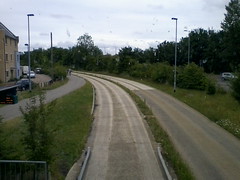
The bus-way starts just outside Cambridge, where the bus leaves the normal road, goes over a car trap (a pit in the center of the roadway to stop ordinary cars driving onto the bus-way)and onto the concrete tracks. The bus-way is mostly built like a concrete railway, with two wide concrete rails (one for each side of the bus) and a raised edge for the guide wheel. There is grass growing between the rails and between the two sets of tracks. The ride is quite bumpy as the bus goes over the joins in the track and also the bus sways from side to side (more so than I remember from the Adelaide bus-way). The swaying is likely more pronounced on the top deck of a double deck bus (Adelaide has had problems with swaying of the rear of articulated buses).

The bus-way follows a disused railway track and at times goes close behind houses, with a high sound barrier on each side (which you can see over from the top deck). Out in the countryside there are wetlands on either side, with people bird watching and fishing. At one point near St Ives there is a marina at the river.

There are several stops along the way with park and ride facilities and I noted one disused railway station. Between St Ives and Huntingdon the bus travels on ordinary roads. To get the guided bus-way experience you might as well just go Cambridge to  St Ives and back.

In 2009 I traveled the 12 kilometers, of Adelaide's O-Bahn Busway which was then the world's longest. The experience in Cambridge is similar. This is not a glamorous mode of travel (like a monorail), but a pratical solution to a particualr problem: where space in confined or ground too soft or undevne for a normal roadway to be built.

The o-bhan bus guidance technology is a simple and proven mechanical system. However, technology has advanced to the point where it should be possible to achieve the same result using electronics. Using automatic lane and cruse control developed for cars and trucks, it should be possible to have buses self steer in bus lanes and keep a safe distance from each other. This should make it possible for buses with no mechanical modifications to travel on an o-bhan bus-way, as well as one on an ordinary roadway. Also it should be possible to use positioning technology and communications technology to safely share one lane for two way traffic.  This would allow, for example, just one lane to be built and passing lanes at the bus-stops. Buses would take turns to use the lane, waiting at the stops (just as trains do on many lines now). This would greatly reduce the cost of the construction of bus-ways. At peak times buses could travel in convoys, with each automatically separated by a safe distance.

Sunday, April 26, 2009

Cambridgeshire Guided Busway

The Cambridgeshire Guided Busway (UK), when completed in late 2009, will be the longest guided bus system in the world. It will use similar technology to the Adelaide O-Bahn Busway, which is currently the world's longest. The guided busways combines the features of a bus and tram. A concrete track is being laid, mostly along the right of way of the disused Cambridge and Huntingdon railway. Small wheels on new buses will allow them to be guided on the track, but also run on ordinary roads between sections of track. This has advantages over a tram, which can only run on track, not ordinary roads. The use of the guideway allows for two tracks (one in each direction) to be laid in a smaller space than a roaidway. However, the system has disadvantages: busses have internal combustion engines (not electrically powered as with most trams) and so create local pollution and then have a lower carrying capacity than multi unit trams.

I have attempted to map the route of the bussway. Note that the route is only approximate and the timings are incorrect (these are based on Google maps estimate of walking speed). Also I attempted to use Googles "my maps" feature, but could not work out how to import the directions.:

View Larger Map

Wednesday, April 22, 2009

Travelling the world's longest Guided Busway

Glenelg to Adelaide Tram at Glenelg
At 12 kilometres, Adelaide's O-Bahn Busway is the world's longest and fastest guided busway. As I was visiting Adelaide to give a talk, I thought I would take a ride before it is eclipsed by the Cambridgeshire Guided Busway (ANU Alumni have been invited to visit Cambridge in July). My hotel was near the Glenelg Tram so I decided to include that in the journey. The tramway runs 12.3-kilometres from the city CBD to the coast south of Adelaide in a straight line. The tram system was refurbished in 2006 with Flexity Classics vehicles from Bombardier and improved track and stops. The network was extended further into the CBD in 2007.

The trams have raised platforms and good separation from traffic (the trams run on their own right of way for most of the trip separated from roadways). Adelaide has a well integrated ticketing system with one ticket working on buses, trams and trains. I was able to purchase an all day ticket from a conductor on the tram. The bus drivers also sell tickets and the trains have coin operated ticket machines. Tickets are validated at the start of each ride with machines near the entrances on the vehicles. Unlike the inconvenient and dangerous Melbourne system, there are no ticket vending machines on the trams.

While the trams are only a few years old, the fabric of the seats are starting to show signs of wear. There appears to be no padding in the seats at all, with thin cloth laid over a very hard plastic shell. A few mm of padding would make the seats a lot more comfortable. The windows of the trams have been covered with advertising on the outside which limits vision through the perforations in the ads. Commuters are unlikely to notice this, but it is annoying for tourists who want to see the view.

The ride of the trams is much better than the old class H trams (which are run on weekends for the tourists) but is still bumpy in places. The few hundred metres of track at Glenegle has a nasty vibration, which made my teeth hurt, and needs work. However, the discomfort is rewarded when the tram comes to a stop at the end of the line in sight of the ocean, with a cafe on one side and a mall on the other.

There are bicycle lockers provided at some stops and bicycles (and surfboards) are not permitted on the trams. The stops are well laid out and designed for long vandal resistant life. There is a sponsored mural near the depot at Glandore.

The section of the line in the Adelaide CBD and at Glenelg is free, providing a very useful service for short journeys. Unfortunately this results in overcrowding of the trams in the CBD. However, this was not as uncomfortable as the loading on the Istanbul tram.

Some of the stops were by request, with an automated announcement advising when the passenger needed to push a button to request a stop. One problem with this is that, unlike a bus, there appeared to be no audio or visual feedback to indicate that the stop request had been received, leaving me wondering if the tram was going to stop. Overall this was an excellent service which should be expanded.

Adelaide O-Bahn Busway

Unlike the trams, which run down the streets of Adelaide, the busway was much harder to find. Google's trip planner advised me to take buss M44 and indicated which stop it left from in the city (in the same street the trams leave from). It would have been useful if the planner indicated what tram stop the bus sto was near, as this is a very long street with a lot of bus stops. Eventually I found the stop and checked the bus had a guide wheel. The wheel looks like one from a children's tricycle, mounted horizontally just behind the front door of the bus. This is linked to the front wheels of the bus and steers it automatically on the busway. I cancelled my ticket in the machine as on the tram. The buses for the buss way look very old and in need of replacement, reminding me of some in India. In particular the articulated buses look very worn (there are technical problems in replacing the articulated buses).

The buses travel slowly through the city traffic, indistinguishable from any other bus (apart from looking a generation older). They then divert onto the busway, past a warning sign to motorists and over a "sump buster" to catch those which did not heed the warning. The busway looks like a children's toy wooden railway rack enlarged. The track is made of concrete sections laid on concrete sleepers. There are gaps between the sleepers where you can see the ground underneath. There is a disconcertingly small lip on the side of the track for the guide wheel. The track for the opposite direction seems very close (with the windows on the right die of the bus limited to only opening a few cm, presumably for safety). It would appear that if the guide system failed the bus would be derailed, colliding with an oncoming bus or plummeting off the bridges into the river, but the other passengers seemed unconcerned.

The busway follows the Adelaide River Torrens Linear Park away from streets, making it feel like a trip in the countryside. The buses travel at 80 to 100 km/h and stop at three interchanges: Klemzig Station, Paradise and Tea Tree Plaza. At each stop the bus leaves the busway and returns to running on a regular road. As a result the busway itself is not very apparent to the commuter.

For a system that has been in use for twenty years, the o-bhan is in good condition. The interchanges look a little dated, the buses look past time for retirement, but the track system looks like it could go on for ever. Adelaide should keep this system.

There is a problem with a slightly bumpy ride with the joins between the sections of concrete track (much more frequent joins that with steel tram lines). These bumps have caused problems with uncomfortable oscillations in new designs of articulated buses, but are also uncomfortable on regular buses. It should be possible to overcome this problem with a computer controlled ferromagnetic damper added to the bus suspension.

Saturday, April 18, 2009

Finding the world's longest Guided Busway

At 12 kilometres, Adelaide's O-Bahn Busway is the world's longest and fastest guided busway. As I am visiting Adelaide, to give a talk, I thought I would take a ride before it is eclipsed by the Cambridgeshire Guided Busway. However, for the visitor it can be a bit hard to find. Adelaide Metro have a web page describing the busway, saying it travels through Adelaide's River Torrens Linear Park to Tea Tree Plaza Interchange, but not where from. Google's trip planner seems to say this is route M44. I will see if I can plot a trip on the new Glenelg Tram and the busway.